Facebook

Indoor vs Covered Outdoor Padel Courts

Indoor vs Covered Outdoor Padel Courts

Every court project starts with the same trade-off. A fully enclosed indoor padel court takes weather off the schedule, but it also adds a building envelope to permit, fund and maintain. The covered-outdoor route starts instead with an outdoor padel tennis court and adds an integrated rain roof above the playing area, so rain no longer decides who plays tonight. This guide compares the three routes owners actually choose — fully enclosed, covered outdoor with a rain roof, and hybrid or phased — on climate fit, capital scope, build timeline and bookable hours.

  • 3build routes compared
  • 5climate profiles rated
  • 1integrated rain-roof system
Padel Tennis Court With Rain Roof

What “Indoor” Actually Buys You

“Indoor” describes an outcome, not a building type. What a club is really buying is a schedule the weather cannot cancel: fixed league nights, prepaid coaching blocks and evening slots that hold their value in the rainy season. Three build routes deliver that outcome — and they differ far more in capital scope than in how the court plays.

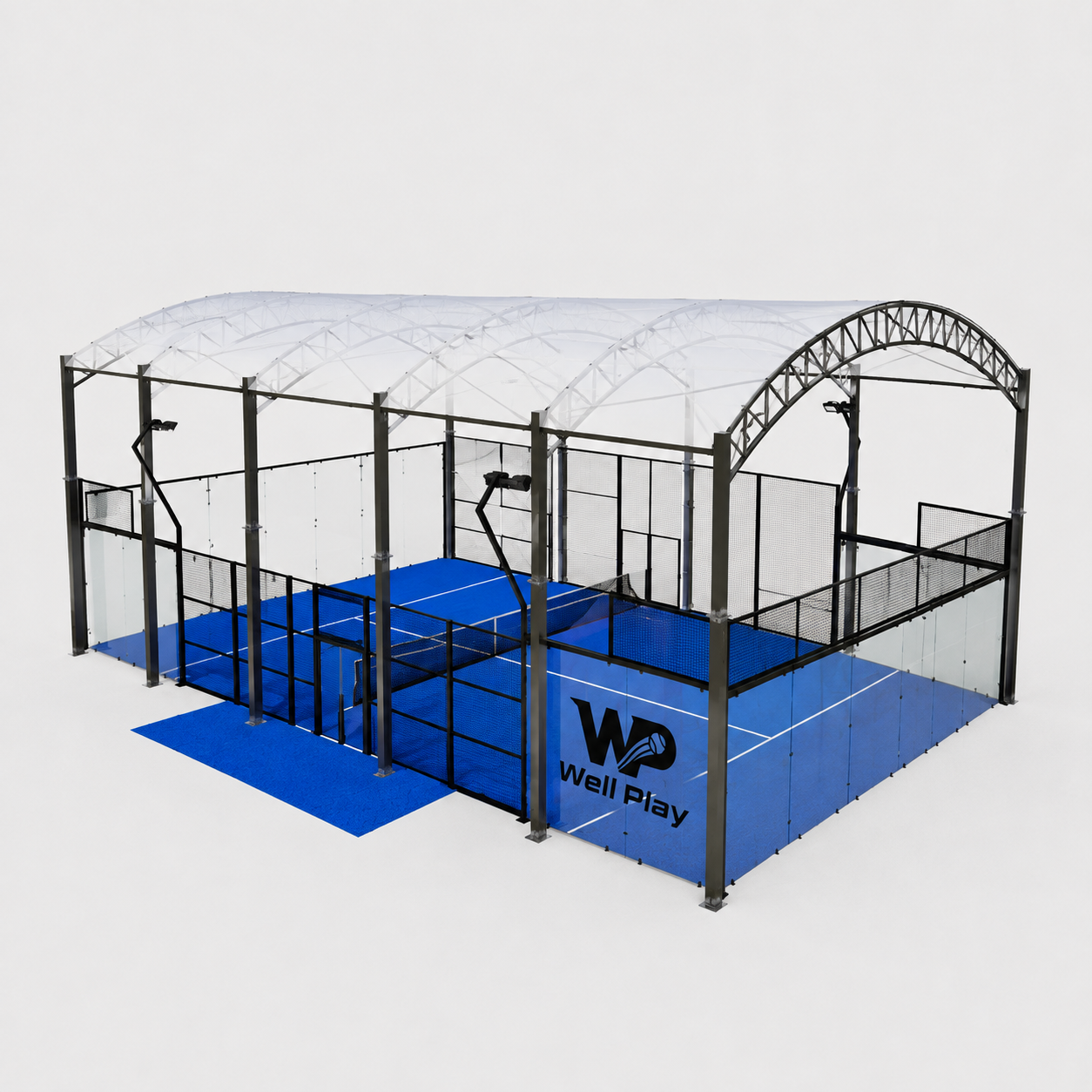
Route A is a fully enclosed building. Route B keeps the standard 20m × 10m playing area outdoors, open at the sides, and adds an integrated rain roof above it — the approach used by the No.WP004 Padel Tennis Court With Rain Roof. Route C is hybrid: build open courts now and reserve the footprint and foundations so a canopy can be added in a later phase. Because the covered-outdoor route is what this manufacturer builds, the honest position matters: a rain roof reduces rain interruptions and extends evening play, but it is not a sealed hall, it does not heat the air around the court, and where hard winters or extreme wind loads dominate, Route A remains the correct answer — the matrix below says so row by row.

Route A

Fully enclosed building

What it is

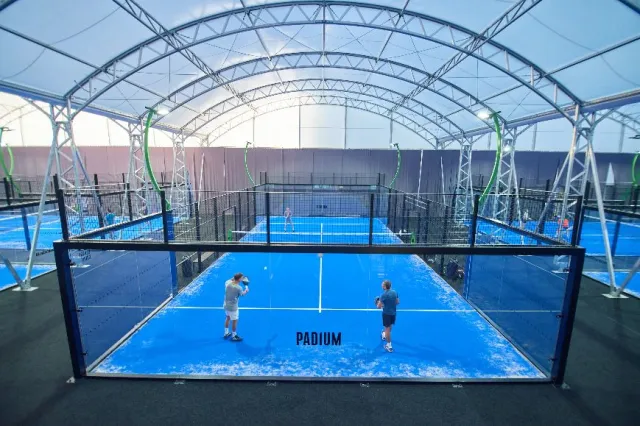
A permanent hall with roof, walls, doors and climate control around one or more courts.

What it is not

Not the only way to reach weather-independent hours, and not the fastest route to first revenue.

Who it suits

Cold-winter and snow regions, sites needing heated comfort, and clubs that must also enclose wind, noise or spectators.
Route B

Covered outdoor with rain roof

What it is

The standard court footprint kept outdoors, with a steel structure, an integrated canopy over the playing area, panoramic glass walls and lighting.

What it is not

Not a sealed hall. The sides stay open, so wind and ambient temperature still affect play.

Who it suits

Rain-heavy but mild or warm climates, resorts and clubs that want more bookable hours without a building programme.

Route C

Hybrid / phased build

What it is

Open courts delivered first, with the site and foundations laid out so a roof structure can be added in a later phase.

What it is not

Not weather protection today, and not a guarantee that a later structure will be approved.

Who it suits

Stage-funded projects, or sites that must prove demand before committing to a covered structure.

Climate-Driven Decision Matrix

Find your site’s weather profile, then read across. The ratings describe fit, not guaranteed performance: local rainfall, wind and snow records should decide the final engineering. Route A = fully enclosed. Route B = covered outdoor with an integrated rain roof (No.WP004). Route C = hybrid or phased.

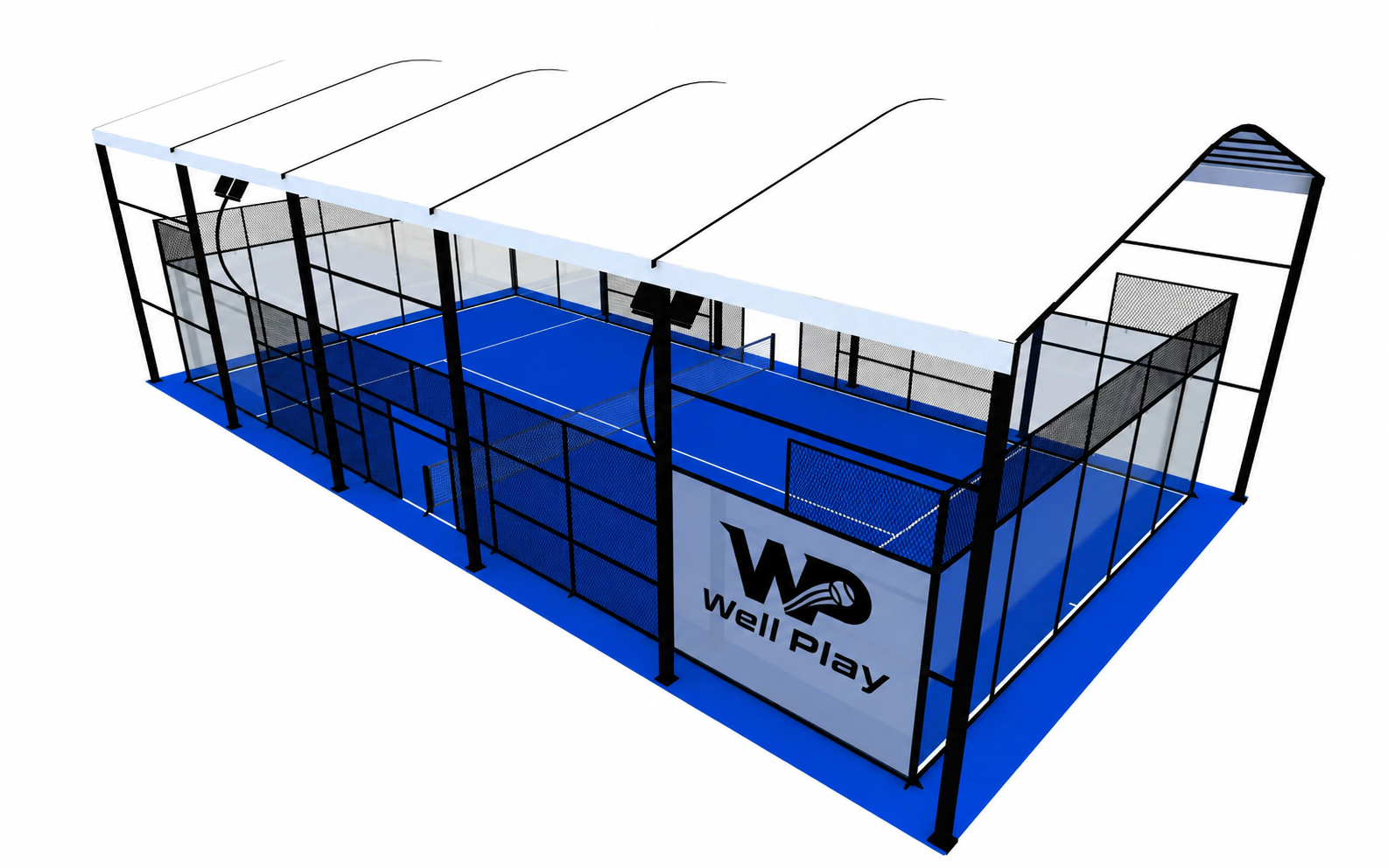
Covered outdoor padel court with rain roof canopy above the playing area
Climate profile Play hours lost without cover Route A — enclosed Route B — rain roof Route C — hybrid Main constraint to design for
Heavy rain season (monsoon, tropical wet) High — whole days rained off Drainage and canopy detailing decide whether the playing area actually stays dry.
Extreme heat and strong sun High at midday Shade over the playing area keeps afternoon and early-evening slots sellable.
Snow and hard freeze Seasonal closure Snow load and freeze-thaw need engineering input; heated indoor space is the direct answer.
High wind or coastal exposure Moderate Open sides let wind cross the court, and salt air makes corrosion protection decisive.
Mild, variable climate Low to moderate Seasonal rain bands, not temperature, are what interrupt play.
If you read one row

Heavy rain season. Rain is what removes whole days from a calendar, and it is the profile where Route B changes the business most: the canopy protects the playing area from rainfall and direct sunlight, and pairing it with professional night sports lighting keeps the same footprint earning into the evening instead of closing at dusk.

The Three Routes, Side by Side

The same eight decisions come up in every project. Compare the lanes attribute by attribute, then read the verdict at the bottom of each. Capital figures are described as relative bands on purpose — your final number depends on site, soil, freight and scope.

Route A — Fully enclosed

Maximum climate control
Permitting

Building permit plus fire, accessibility and local planning approvals.

Structural scope

Foundations, walls, roof, insulation, doors and mechanical ventilation.

Capital band

Highest — a site-built envelope plus building services.

Build timeline

Longest — design approval, construction and fit-out before the first booking.

Bookable hours gained

Maximum: weather and season are removed from the equation.

Retrofit potential

Low — the hall is built in one step and cannot easily start open.

Spectator visibility

Controlled indoor viewing, gallery and seating options.

Flexibility / resale

The building is fixed and suits indoor sport use.

Choose Route A if winter closes your courts, members expect heated comfort, or the site needs a sealed facility for wind, snow, noise or neighbour reasons.

Route B — Covered outdoor, rain roof

Rain removed, budget preserved
Permitting

Usually lighter than a building, but the structure still needs local approval.

Structural scope

Steel frame, canopy roof, glass walls, turf and lighting on the existing court footprint.

Capital band

Mid — a component system without a building envelope or HVAC.

Build timeline

Shorter — production followed by on-site assembly.

Bookable hours gained

Rain interruptions reduced, plus evening hours once night lighting is switched on.

Retrofit potential

Can be installed over an existing outdoor court footprint.

Spectator visibility

The panoramic glass system keeps sightlines open between players and spectators.

Flexibility / resale

Modular: the court remains an outdoor court underneath the canopy.

Choose Route B if rain — not cold — is what cancels play, and you want the added hours without a building programme.

Route C — Hybrid / phased

Fastest to first revenue
Permitting

Staged: open courts are the simplest stage-one approval.

Structural scope

Court, turf and foundations first, with the roof reserved for phase two.

Capital band

Lowest first tranche, with staged spend across seasons.

Build timeline

Fastest first courts; the canopy waits for a later phase.

Bookable hours gained

None at stage one — the benefit arrives only when the roof is added.

Retrofit potential

Highest — the site is designed for a later canopy.

Spectator visibility

Fully open at stage one; visibility changes when a structure is added.

Flexibility / resale

Highest — the project can stop after phase one if demand disappoints.

Choose Route C if funding is phased, or if you need proof of demand before committing to a covered structure.
Fairness note

Route A wins on climate control, thermal comfort and winter play, and no canopy matches a sealed building on those points. Routes B and C win on capital band, footprint flexibility and speed to first revenue. Most stalled projects are ones that budgeted for a building and only needed a roof.

Anatomy of a Rain-Roof Court

The covered-outdoor route is a system, not a tent. Every element below is specified on the No.WP004 product page, and each one answers a question a club owner asks before signing: will it keep the court dry, will it survive outdoors, and will it look professional from the car park?

Annotated padel tennis court with rain roof showing canopy, steel structure, glass walls and turf 1 2 3 4 5 6
  1. 1Integrated rain roof over the playing area — protects the court from rainfall and strong sunlight.
  2. 2Professional night sports lighting — the reason the covered court can keep earning after sunset.
  3. 3High-quality Q235B steel columns, hot-dip galvanized and powder coated for corrosion resistance.
  4. 4Mesh panels: 50 × 50 × 4 mm grid in a 50 × 30 × 2 mm powder-coated steel tube frame.
  5. 512 mm tempered safety glass in a panoramic glass system, keeping spectator sightlines open.
  6. 6Professional artificial turf, PP + PU backing and 12 mm pile height, in blue, green, purple or pink.

Reliable rain protection

The canopy is designed to keep rainfall and direct sun off the playing surface, so fewer sessions are lost to weather.

Buyer decision: ask what is protected — the court, or just the walkway.

Higher court utilisation

Fewer rain interruptions mean more bookable hours, and professional lighting extends operating time into the evening.

Buyer decision: count evening slots, not just daytime hours.

Built for outdoor durability

Galvanized and powder-coated steel, tempered glass and commercial turf are combined for long-term outdoor use.

Buyer decision: coastal and monsoon sites should compare the galvanizing specification first.

Panoramic and customizable

The glass system keeps the court open and professional, and colours, turf, logos, branding, lighting and accessories can be customized.

Buyer decision: decide branding before ordering, not after installation.

Materials & Specification Table

These are the published figures for the No.WP004 rain-roof court. Use them as the baseline when comparing quotes: structure grade, glass thickness and turf build are what separate a court that survives a decade outdoors from one that does not.

Padel Tennis Court With Rain Roof,Well Play Padel - Best Padel Court Manufacturer,Padel Tennis Court With Rain Roof
  • Court size20m × 10m (200 m²)
  • MaterialHigh-quality steel, tempered glass, artificial turf
  • RoofWith rain roof
Component Specification
Column High-quality Q235B steel, hot-dip galvanized, powder coated
Mesh 50 × 50 × 4 mm grid with 50 × 30 × 2 mm steel tube frame, powder coated
Tempered glass 12 mm thick
Artificial turf PP + PU backing, 12 mm pile height
Standard turf colors Blue / Green / Purple / Pink
Customization Color / Logo / Turf / Lighting / Accessories
Roof Integrated rain roof over the playing area

Steel — as stated on the product page

Q235B steel is hot-dip galvanized and powder coated. The page states that the zinc layer isolates corrosive media, that weather resistance is improved by 2–3 times, and that the scratch-resistant surface is easy to maintain. This is the specification that carries the most weight in coastal or monsoon projects.

Glass — as stated on the product page

12 mm tempered safety glass is specified with no sharp edges when broken. The page states 3–5 times the impact resistance of ordinary glass, resistance to a 200 ℃ temperature difference, and bending resistance 3–4 times higher than ordinary glass. Glass is where unsupervised public venues and tournament venues get their safety margin.

Turf — as stated on the product page

Professional artificial turf with PP + PU backing and a 12 mm pile height, described as anti-slip and wear-resistant with strong drainage, and suitable for frequent commercial use. Drainage is what decides whether the court is playable an hour after a downpour.

Padel Tennis Court With Rain Roof,Well Play Padel - Best Padel Court Manufacturer,Padel Tennis Court With Rain Roof

Match the Venue to the Specification

The same rain-roof system is configured differently for a hotel, a tournament venue and a public complex. Start from your venue type, and the specification decisions follow from it — that is the brief to send with your enquiry.

Commercial padel club, multi-court project

Specify

The same column, mesh, glass and 12 mm turf specification on every court, with uniform night lighting.

Why it matters

One maintenance routine, one spares list and consistent playing conditions across all courts.

Hotel, resort and high-end property

Specify

Custom turf color, logo and branding on the structure, plus the panoramic glass configuration.

Why it matters

The court reads as part of the property instead of equipment dropped onto the grounds.

Public or private sports complex

Specify

Hot-dip galvanized, powder-coated Q235B steel and 12 mm tempered safety glass throughout.

Why it matters

Corrosion resistance and glass safety carry the most risk in unsupervised public use.

Tournament venue and outdoor arena

Specify

Panoramic glass walls and professional night sports lighting as standard, not as an upgrade.

Why it matters

Spectator sightlines and evening scheduling are what make a tournament calendar work.

Recreational facility with a wet season

Specify

The integrated rain roof over the full 20m × 10m playing area, prioritized over other extras.

Why it matters

Rained-off sessions, not slow bookings, are usually the first commercial problem on site.

Coastal or salt-air site

Specify

Galvanized and powder-coated steel confirmed in writing, plus turf drainage suited to heavy rainfall.

Why it matters

Salt air attacks structure before it attacks anything else on a padel court.

Related Reading

Three notes to help clarify product requirements before contacting the supplier.

How 20m x 10m padel court specs shape structure and visibility

A 20m x 10m padel court specification helps buyers connect court scale, structural layout, enclosure materials, and spectator visibility in one reading.

Read article

Covered padel court vs outdoor padel court when a rain roof changes use

A rain roof changes how a padel court works in practice, but it does not erase the difference between covered, canopied, and fully open outdoor layouts.

Read article

What a rain roof padel court means for covered outdoor play

A rain roof padel court adds overhead shelter to an outdoor padel court so play can continue with fewer weather interruptions.

Read article

Frequently Asked Questions

is a covered outdoor court the same as a fully enclosed one?

no. a covered outdoor court keeps the standard 20m × 10m playing area open at the sides and adds an integrated rain roof above it, so rain and direct sun are blocked while wind and ambient temperature still affect play. a fully enclosed court is a sealed building with walls, doors and climate control. the covered route reduces rain interruptions; the enclosed route removes weather entirely.

what are the dimensions and materials of the no.wp004 rain-roof court?

court size is 20m × 10m (200 square meters). the structure uses high-quality q235b steel, hot-dip galvanized and powder coated; mesh with a 50 × 50 × 4 mm grid in a 50 × 30 × 2 mm powder-coated steel tube frame; 12 mm tempered safety glass; and professional artificial turf with pp + pu backing and a 12 mm pile height.

can the colors, logos and lighting be customized?

yes. the product page lists customization of color, logo, turf, lighting and accessories, with custom colors and branding available and project-specific configurations offered. standard turf colors are blue, green, purple and pink.

does the rain roof mean the court never closes?

the integrated rain roof protects the playing area from rainfall and strong sunlight, which the product page presents as less weather interruption and more playing time. wind, ambient temperature and extreme snow loads are separate questions and should be reviewed for your site — where those dominate, a fully enclosed court remains the right answer.

how is the court lit for evening play?

the system is designed to be paired with professional night sports lighting so play can continue after dark, and lighting is listed among the customizable items. confirm the lighting plan as part of your project specification before ordering.

how do i get pricing and a project quote?

pricing is quote-based — the product page publishes no price and no lead time. send your court count, site location, climate profile and branding requirements through the contact us page, where the form is set up for rfq submissions, and the team will come back with a configuration and quotation.

Leave a message
Name
Whats App *
E-mail
Message
We use Cookie to improve your online experience. By continuing browsing this website, we assume you agree our use of Cookie.